As envisioned by the National Education Policy 2020, Florence Academy integrates experiential learning, competency-based assessment, critical thinking, and technology-enabled education across all subjects and laboratories.
Mathematics Laboratory:
The Mathematics classroom and lab at Florence Academy promote conceptual clarity through activity-based and experiential learning. Students engage in hands-on activities using mathematical models, puzzles, manipulatives, and real-life problem-solving tasks. Emphasis is placed on logical reasoning, analytical thinking, data interpretation, and application of concepts rather than rote procedures. Collaborative learning, math projects, and competency-based assessments ensure deeper understanding and confidence in mathematical thinking.
Computer Science Laboratory:
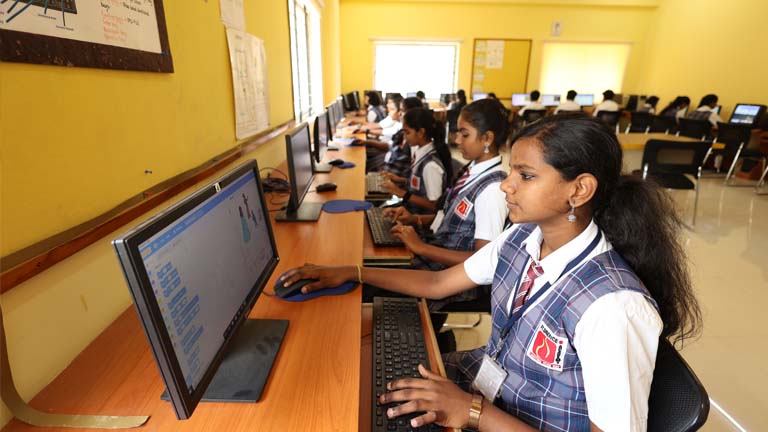
The Computer Lab is designed to develop digital literacy, computational thinking, and coding skills in alignment with NEP 2020’s focus on technology integration. Students are introduced to programming, artificial intelligence awareness, data handling, and digital creativity through project-based learning. The lab encourages innovation, problem-solving, ethical digital practices, and hands-on exploration, preparing learners for a technology-driven world.
Physics Laboratory:
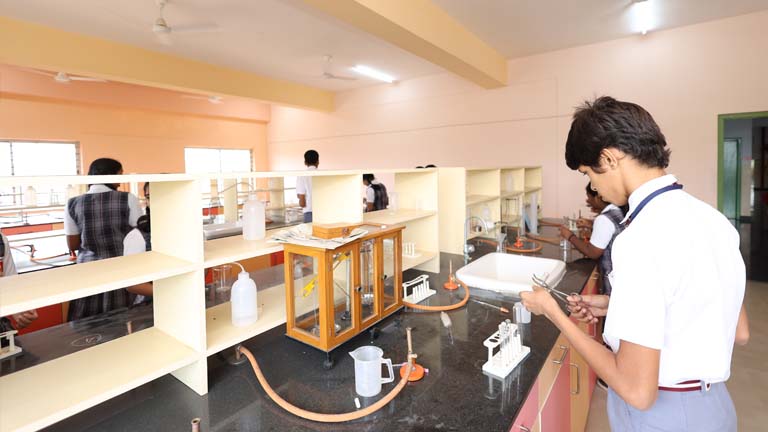
The Physics Lab emphasizes experiential and inquiry-based learning. Students perform experiments, verify principles, and analyze real-world applications of physical laws. Through observation, measurement, experimentation, and project work, learners develop scientific temper, analytical skills, and conceptual understanding. Assessment focuses on practical application, interpretation of results, and investigative skills.
Chemistry Laboratory:
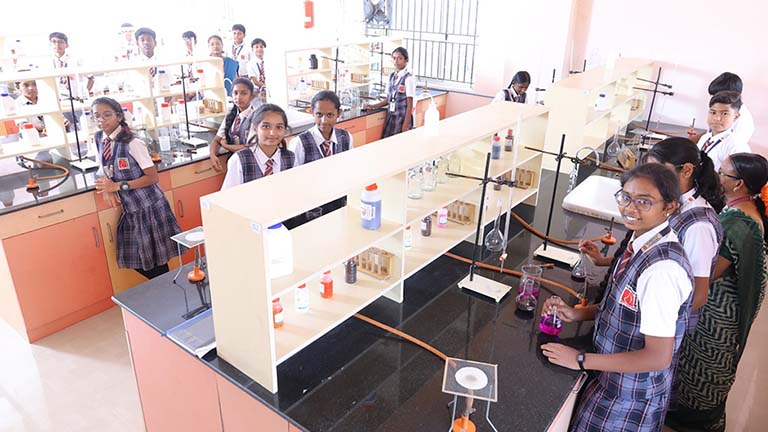
The Chemistry Lab provides a safe and well-equipped environment for hands-on experimentation. Students conduct experiments to understand chemical reactions, properties of substances, and laboratory techniques. Inquiry-based learning, observation skills, and analytical reasoning are emphasized. Practical work supports theoretical knowledge and nurtures curiosity, precision, and scientific inquiry.